
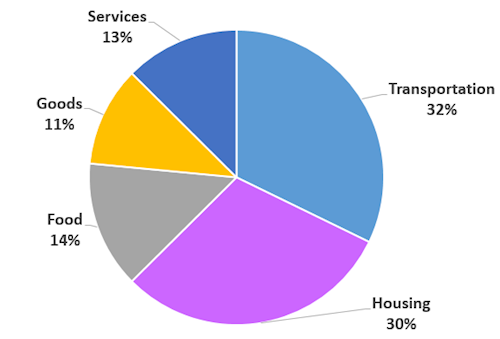
This chart shows the average across all households in Dane County but of course there’s a range of emissions values; folks living in urban areas typically have lower transportation emissions whereas people in apartments are likely to have lower household emissions than residents in big houses. Check out the map of emissions by zip code area to explore the data more fully.
The largest source of emissions for households in Dane County is transportation, which includes the fuel you consume but also the emissions associated with manufacturing your vehicles. The next largest category is housing, which includes the emissions from the home's construction as well as the utiltiies you use. Other categories include goods (the furniture, etc you buy) and services (health care, finances, car and household maintenance and other services you use), and the food you eat.
The most important strategies for reducing energy use at home include turning appliances off when not in use and improving your home’s overall energy efficiency.
If you don’t know where to start, a home energy audit is the best first step. A home energy audit, or energy assessment, can help you understand the whole picture of your home’s energy use and determine areas where your home can become more efficient. The audit will reveal the areas for the greatest energy efficiency improvements and greatest potential energy savings as well as electrification opportunities. Then you can make a plan for how to prioritize making those upgrades.
Focus on Energy has free energy-saving packs to help you reduce your energy use at home.
One of the most important ways homeowners can reduce their carbon footprint is by ensuring that the energy used to heat and cool their home is not wasted. Together, air sealing and insulation upgrades are effective tools to reduce your energy consumption and lower your carbon footprint.
You should always opt for the most efficient model when choosing home appliances. The easiest way to find energy efficient products is to look for the ENERGY STAR label.
Many local libraries also have portable energy meters that you can borrow; these meters enable you to measure the electric usage of specific appliances.
Check out our resources on improving home energy efficiency.
Electrifying your home can reduce your greenhouse gas emissions, improve your indoor air quality, and save you money.
Households in Dane County create about 8% of total countywide greenhouse gas emissions. Going all-electric is one way to reduce your emissions while creating a more comfortable home. For example, if you get an induction stove you are not only cooking more efficiently but also making the air in your home cleaner. Additionally, installing an air-source heat pump can vastly reduce your energy bills because it efficiently moves hot air around your home, in contrast to a boiler that takes time to heat up . And as utility companies incorporate more renewable energy into the electric grid the electricity you buy becomes cleaner.
Once you know your highest priority priorities for electrification, check out our resources on how to electrify your home to get started.
Rewiring America also has a wealth of resources to help you make the transition.
You can power your home with renewable energy by either installing a renewable energy system on your home or property or by purchasing green power from your electric utility.
Learn more about installing solar or purchasing green power.
And take a look at what Dane County is doing to keep its facilities using 100% renewable energy.
More than 4,150 solar installations serve Dane County; take a look to find out where solar is in your community and how it's being used.
For most Americans, the two big sources of emissions in our lives are where we live and how we move around our communities. Our affinity for driving has negative health impacts as well as environmental and economic impacts.
Visit our Transportation Page to read about each clean transit option
According to Project Drawdown, two of the biggest opportunities to reduce emissions are reducing food waste and adopting a plant-rich diet.
Experts estimate that about one-third of all food produced is wasted, either damaged in transit or spoiled before consumption.
In addition to reducing waste, composting leftover organic materials is another way to reduce your footprint. If you don't have space to compost in your backyard you can sign up for a compost service which will take your food scraps for composting. You can also join Dane County's Food Scrap Program to drop your compost off at drop-off locations across the County.
Learn more about how to take action to reduce your food waste.
Focus on Energy is Wisconsin's statewide energy efficiency and renewable energy program, which offers technical assistance and incentives to help you become more energy efficient:

Learn where your emissions come from with the Carbon Calculator below.

More than a checklist, SHIFT invites a change in mindset. By connecting personal action with structural change, SHIFT shows how every one of us can make a tangible difference, right now, right where we are, with the resources we have at hand