Since June of 2024, Home Energy Guides (HEG) has partnered with community-based organizations (CBOs) to deliver historic clean energy federal funding in the hands of disadvantaged Dane County residents. In the past 18 months, I oversaw the administration of over $267,000 to eight CBOs with one goal: increase participation in residential energy efficiency and electrification programs. When I joined this initiative, I couldn’t have foreseen the immense challenges HEG and our partners would overcome, and the invaluable lessons our office would learn. As my tenure with the Office of Energy & Climate Change (OECC) comes to an end, I want to reflect on what it means to implement an energy efficiency program at a time of institutional uncertainty and state-sanctioned hostility.
HEG exists because OECC had the foresight to know that CBOs are the ones best positioned to deliver a community engagement program such as this. Convincing residents who have been historically marginalized and outright discriminated against by the decision-makers to trust in government programs requires significant amounts of trust. CBOs, often embedded in their communities for years, have a level of resident trust OECC cannot replicate. OECC could’ve delivered this program alone and tried to overcome the justified barrier of mistrust between residents and the government, or it could provide CBOs the right tools to leverage their local knowledge, community expertise, and authority in their respective communities.
Since September of 2024, Guides, people from the same communities we prioritized, were trained in building science, energy communication, and energy program fluency, to help fellow community members identify suitable energy programs and lead them though complex application processes. The Guides’ support included helping residents gather documentation, troubleshooting application issues, and mediating contractor conversations. They answered resident questions and advocated for their clients.
But an incoming administration that is at best indifferent and at worst hostile towards the same residents we want to help, deeply hindered the Guides’ ability to overcome justified apprehension towards government institutions and programs. Moreover, the surge of immigration law enforcement activity has created an air of insurmountable fear and has reset resident priorities. Concerns over proper insulation and efficient heating equipment pale in comparison to concerns over safety, or life and death.
In addition to resident mistrust, institutional volatility—disappearing grants, federal agency furloughing, anti-climate messaging—threatens the trusts CBOs have in us, OECC as a government entity, and our ability to continue partnering and collaborating in the future.
Despite these challenges, HEG was able to demonstrate that trust is a key ingredient to meaningfully engage disadvantaged communities, even when it’s externally eroded. In a year and half, Guides painstakingly cultivated resident trust in government-funded energy programs. Trust cannot be built in a few short months, it needs years of consistency, reliability and honesty. HEG is a first step in getting communities to trust in us and our programs. However, with only three months to HEG, there much still left to be done and many unrealized opportunities. The temporariness of grants like HEG is disruptive to community trust-building. Program longevity is foundational to maintaining partner relationships. Our partners have expressed disappointment over the impending end of HEG in May 2026, feeling like they needed more time to utilize the momentum and trust they gained.
Overall, in an era of funding scarcity and national institutional collapse, HEG proves that the most impactful work happens at the local level, and that resilience can be achieved when partners come together to do what needs to get done.
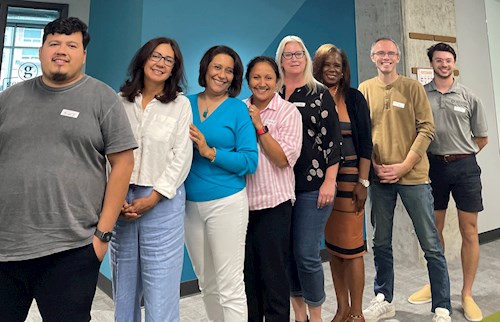
Our partners are HEG’s backbone, and the Guides its heart. Wisconsin EcoLatinos, the Hmong Institute, Blacks for Political and Social Action of Dane County, Latino Professionals Association, Latino Academy of Workforce Development, Northside Planning Council, Project Home, Cornerstone Community Center—these are the partners that made HEG possible. Alejandra, Lulu, Dama, Noly, Hema, Nina, Carla, Lina—these are the names of the Guides who are out in the community connecting residents with valuable resources. There are no words that can capture my gratitude and appreciation for these partners and Guides, whose contributions are what make HEG special. Thank you.
I will leave with a few words from Marisol, a resident who participated in HEG and received $10,000 in HOMES rebates. Her experience captures the benefits a program like HEG. Marisol, in October 2025, dreaded what another cold, damp winter would do to her children’s health, and felt like she had no options to alleviate her concerns. When asked how she and her family navigated an especially harsh winter, she said,
“…The new insulation has made a big difference. This winter felt much warmer in our home, and we noticed that our utility bills decreased by about 30 percent… Thank you again for all the support your program provides. It has truly made a positive difference for my family.”

As a U.S. Department of Energy Community Energy Fellow, Eneida supports Dane County’s Energy and Climate Change office with the Home Energy Guides program, through which she coordinates with community-based organizations to help increase Justice40 household participation in energy efficiency programs.
The Dane County Office of Energy & Climate Change maintains this blog as a way to offer:
To be sure that you don't miss new blog entries, subscribe to our email updates.